Warehouse Staffing Background Checks: Package the Assignment, Not the Person
AI in Background Screening: Faster Hires Without the Compliance Risk
June 16th, 2026
Your best candidate can accept another offer while your background check is still “processing.”
That is not usually because the candidate failed the check. It is because the process moved too slowly. The employer waited. The candidate kept interviewing. Somebody else got to yes first.
That is why so many companies are looking at AI background check software. The instinct is reasonable. If AI can remove manual drag from the screening process, employers can hire faster and keep good candidates moving.
But there is a line that matters.
AI can help collect, route, and prioritize background screening work. It should not be the final decision-maker on record matches, current dispositions, adverse action, or whether a candidate is cleared for hire.
That is where speed turns into risk.
Background screening is not just a data problem. It is a legal, operational, and human judgment problem. Used well, automation makes the process faster and cleaner. Used badly, it can attach the wrong record to the wrong person, miss updated court outcomes, or push an employer toward a decision that should have been reviewed by a trained person.
Here is the practical version: AI belongs in the background of background screening, not in the final call.
Where AI background check software actually helps
The best use of AI in background screening is not “the machine decides.” It is “the machine removes work that never needed a human in the first place.”
That matters because most screening volume is routine. Many reports are clean. Many checks follow a predictable path. The operational drag comes from forcing people to spend time on work that software can sort, structure, or route faster.
1. Faster database scans
National criminal database searches and other broad database checks can scan aggregated record sources quickly. That makes them useful as a first pass.
A database search can help identify potential records that may need more review. It can also help return clean results faster when there is no apparent record activity.
The important phrase is first pass. A database hit is not always final, complete, or current. For employment screening, potential criminal records often need source-level verification, especially when the result could affect a hiring decision.
2. Smarter routing and triage
A good screening workflow should not treat every report as equally complex.
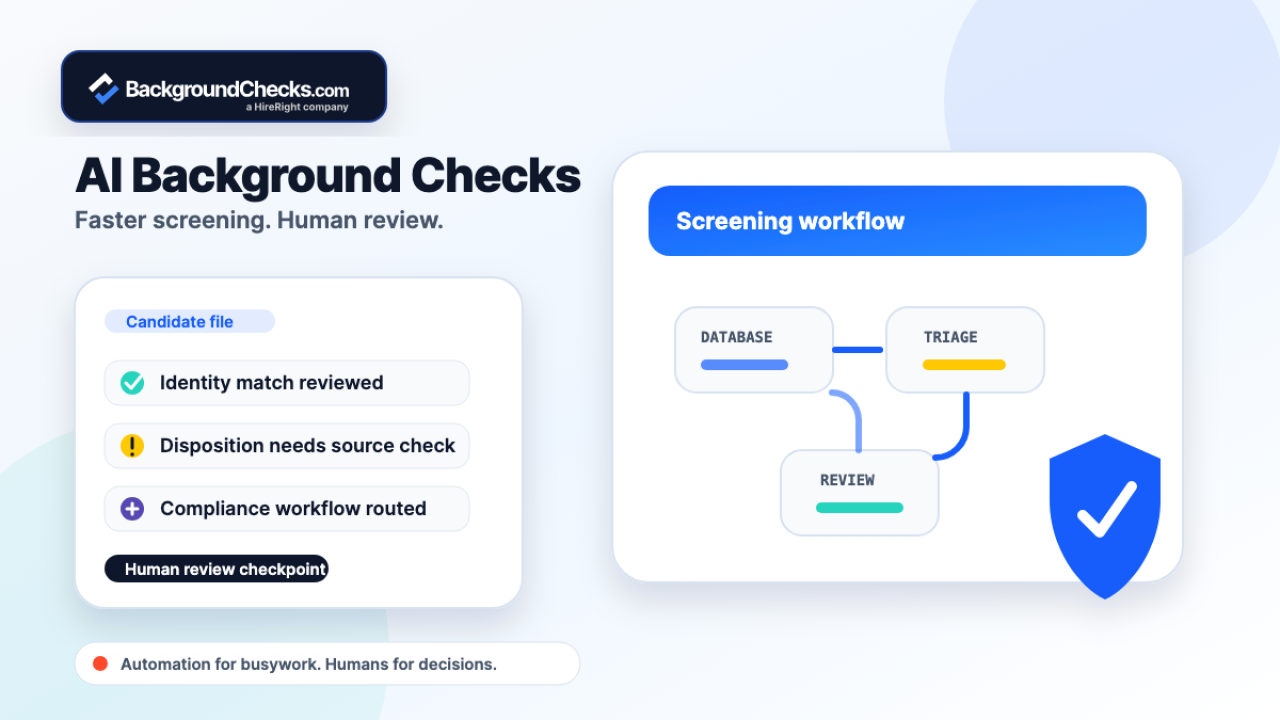
AI and automation can help separate straightforward reports from reports that need trained review. Clean reports can move quickly. Potential hits, identity conflicts, stale records, jurisdiction-specific questions, and adverse action issues can be routed to human reviewers.
That is the real speed story. Automation should clear the reviewer’s desk of busywork so the reports that carry risk get more attention, not less.
3. Better status visibility
Employers do not just need faster screening. They need to know what is happening.
Automation can improve status updates, candidate reminders, workflow notifications, and document collection. That reduces the “black box” feeling that frustrates hiring teams and candidates.
This is especially useful when a check depends on a candidate completing authorization forms, a court responding, or a verification source confirming employment or education history.
4. Faster employment and education verifications
Employment and education verifications are often slowed down by manual follow-up. Automation can help match submitted information, organize outreach, detect missing data, and keep verification workflows moving.
That does not mean every verification should be accepted without review. It means the repetitive parts of the process can be handled faster so reviewers spend time on exceptions, conflicts, and judgment calls.
Where pure automation creates compliance risk
The sales demo usually shows speed. It rarely shows the ugly cases.
The ugly cases are where background screening risk lives.
Common names and false matches
One John Smith born in 1985 is not the same as another John Smith born in 1985.
Over-aggressive matching can attach a record to the wrong person. That is not a small technical error. In an employment context, a false match can cost a candidate a job opportunity and put the employer and screening provider in the middle of a dispute.
Matching logic needs discipline. It needs identifiers. It needs source confirmation when the record may affect employment. It also needs a human who can recognize when the data is not strong enough to report as a match.
Stale or incomplete dispositions
A database may show an arrest or initial charge without showing what happened later.
Maybe the case was dismissed. Maybe the charge was reduced. Maybe the record was updated, sealed, or expunged. If the report shows the old event without the current public record status, the result can be misleading.
That matters under the Fair Credit Reporting Act. For public record information used for employment purposes, consumer reporting agencies must either notify the consumer when public record information is reported or maintain strict procedures designed to ensure the information is complete and up to date.
In plain English: if a record can hurt someone’s employment opportunity, current status matters.
Jurisdiction-specific rules
Background screening is not governed by one simple national rule.
Employers may need to account for the FCRA, state law, local fair chance rules, ban-the-box timing, lookback limits, role-specific requirements, and adverse action steps. Court access and database coverage also vary by jurisdiction.
A simple rule engine can miss that nuance. A purely automated decision can move too quickly past facts that should slow the process down.
Adverse action is not a software shortcut
If an employer may take adverse action based on a background check, the process needs care. Candidates generally must receive the required notice, a copy of the report, and a chance to review or dispute information before final adverse action is taken.
That is not a box to click after an algorithm flags someone. It is a compliance workflow that protects the employer and the candidate.
AI can help organize the workflow. It should not replace the judgment required to decide whether the report is accurate, relevant, current, and ready for employer review.
Our line: AI in the back, humans on the call
The future of background screening is not humans or machines. It is the right division of labor.
At BackgroundChecks.com, the defensible model is simple:
Automation handles aggregation, workflow routing, status updates, and first-pass triage.
Human reviewers handle record verification, source checks, disposition review, exception handling, and compliance-sensitive judgment calls.
Employers keep control over hiring decisions, using screening reports and adverse action workflows appropriately.
The machine should make the work faster. It should not decide who gets a job.
That distinction is not anti-technology. It is pro-accuracy.
A fast clean report is valuable. A fast wrong report is a liability. The goal is not to stamp “AI-powered” on the sales page. The goal is to return clear reports quickly while slowing down the reports that deserve scrutiny.
That is how you get speed without turning screening into a lawsuit generator.
What employers should ask before buying AI screening tools
If a vendor is selling AI background check software, ask practical questions before you trust the workflow:
What does the AI actually do: routing, matching, summarizing, adjudication, or decision support?
Are potential criminal hits verified at the source before they are reported for employment use?
Who reviews common-name matches and identity conflicts?
How are updated dispositions, dismissals, expungements, and sealed records handled?
How does the system account for state and local rules?
Does the platform support disclosure, authorization, pre-adverse action, adverse action, and dispute workflows?
Can a human explain why a record was included or escalated?
Does the vendor make hiring decisions, or does the employer retain that responsibility?
If the answer is “the algorithm handles it,” that is not a feature. That is a warning sign.
A faster background check still needs a defensible process
Fast and compliant are not opposites.
The problem is when vendors treat them that way. Some over-trust automation. Others under-invest in workflow and human review. Both approaches create problems: either the process is fast but fragile, or careful but too slow to support real hiring.
The better model is not complicated:
Automate the busywork. Keep humans on the decisions that can hurt candidates and create legal risk. Give employers clear status, practical support, and a screening workflow designed around both speed and responsibility.
That is the version of AI in background screening worth using.
If you want a screening partner built around that balance, BackgroundChecks.com combines fast turnaround, transparent pay-as-you-go pricing, built-in compliance workflows, and real human support.
You can also read TechRadar’s independent BackgroundChecks.com review here: https://www.techradar.com/pro/backgroundchecks-com-review
FAQ
Is AI background check software FCRA compliant?
AI software is not automatically FCRA compliant or non-compliant. The issue is how it is used. Automation can support an FCRA-aware workflow, but employment background checks still need accurate reporting, proper authorization, compliant adverse action steps, and human review where records may affect a hiring decision.
Can AI make background checks faster?
Yes. AI and automation can speed up database scans, routing, status updates, candidate reminders, and verification workflows. The safest use is to automate repetitive process work while keeping trained reviewers involved in record matches, dispositions, and exceptions.
Should employers let AI decide whether a candidate passes a background check?
No. Employers should be cautious about any workflow where AI makes final employment decisions or automatically treats a potential record as disqualifying. Screening providers can help organize and verify information, but employers remain responsible for their hiring decisions and adverse action process.
What is the biggest risk with automated background checks?
The biggest risk is reporting inaccurate, incomplete, or mismatched information quickly. Common-name false matches, stale dispositions, and jurisdiction-specific rules are exactly the kinds of issues that require careful review before a report affects employment.
Get an Account Today!
Our screening process is built for speed, volume, and support. You can create an account today!

Need Background Checks?
See packages and pricing and order instantly.
National, County, Statewide, Federal Criminal Searches
Motor Vehicle Records
Employment & Education Verifications
Bankruptcies, Liens, & Judgments
Drug Testing
Recent Posts
AI in Background Screening: Faster Hires Without the Compliance Risk
HireRight vs. BackgroundChecks.com: Which Background Screening Platform Fits Your Business?
Background Check Pricing in 2026: What You Should Expect to Pay (and How to Avoid Hidden Fees)
Drug Testing for Employers: 5-Panel vs. 10-Panel Options Explained